
One can only envy Olivia Wilde’s strength and confidence. In 2021, the filmmaker found herself at the center of a scandal even before the release of her new film “Don’t Worry Darling” — due to her romance with Harry Styles, her departure from her family, and reported problems on set, where her colleagues, including lead actress Florence Pugh, were said to be unhappy with Wilde’s unprofessional behavior. At least, that is what the tabloids claimed, so the film itself was pushed to the background. And there was little to celebrate there: “Don’t Worry Darling” pleased neither critics nor audiences, did not perform particularly well at the box office, and seemed to put a definitive end to Wilde’s career.
As it turned out, prematurely. With her very next project, the comedy-drama “The Invitation” about relationships, Wilde returned to the big screen with a splash at Sundance. About 100 people could not get into the first screening at the festival’s largest venue, the Eccles Theatre in Park City, and organizers had to add extra screenings so that everyone could see the film. As a result, “The Invitation” became the most sought-after title of the festival, sparking a fierce bidding war among distributors that lasted three days.
Several major players fought for the new film — A24, Neon, Searchlight Pictures (a Disney division), Focus Features (Universal), Netflix, and even the new Warner Bros. studio for auteur and independent projects. In the end, A24 acquired it for over $12 million — a substantial sum, though not the largest in Sundance history.
Formally, Wilde’s new work is a remake of the 2020 Spanish film “The Neighbors from Upstairs,” which spawned six remakes at lightning speed, including a Russian one (“Unwelcome Guests”). The reason is the central plot twist: the neighbors turn out to be not ordinary people but enthusiasts of sex parties (a twist so widely advertised that it can hardly count as a spoiler). The script was adapted for American screens by Rashida Jones and Will McCormack (who wrote “Toy Story 4,” among other films). Without having seen the original, it is hard to say how much they changed it, but calling the film a “sex comedy” would be a significant overstatement.

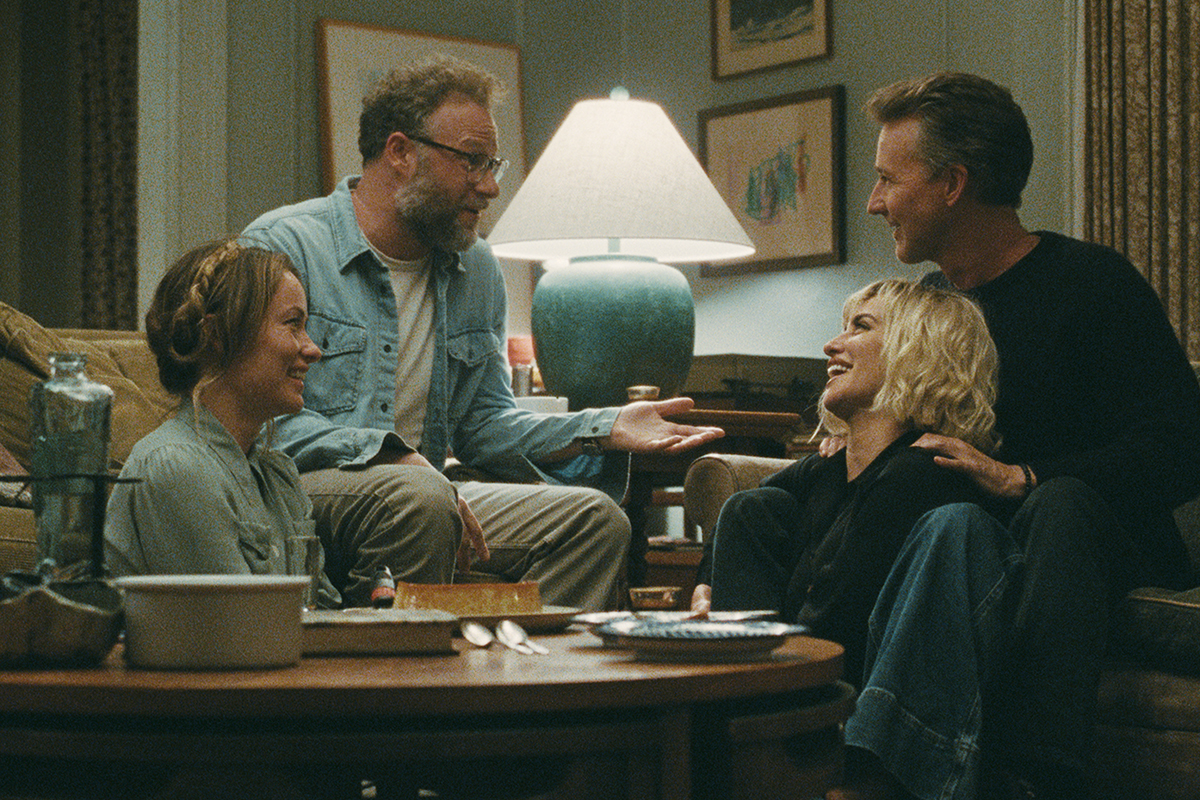
Though “The Invitation” flirts with bedroom themes, Wilde clearly aims higher and plays with the legacy of great predecessors — “Who’s Afraid of Virginia Woolf?” and “Scenes from a Marriage” — following all the tropes of the genre. There are sharp, witty dialogues and sparring matches, flirtation and the attraction of opposites that will ultimately lead to catharsis… or catastrophe. And the actors throw themselves into the dance with full commitment: Wilde plays a nervous, lost housewife; Seth Rogen — a sad joker hiding his depression behind a stream of jokes; Penélope Cruz — an exotic European who draws attention; and Ed Norton — an agreeable good soul who does not take offense even at the harshest remarks. Wilde’s directorial approach — long rehearsals with the cast, shooting scenes in order, and freedom for improvisation — clearly helped them loosen up and create an atmosphere of trust.
The film does not rely on its outstanding cast alone. Cinematographer Adam Newport-Berra (“The Bear,” “Euphoria,” “The Curse”) is no stranger to shooting interiors, and his camera glides through Joe and Angela’s impeccably furnished apartment in every shade of green, building a contrast between outward bourgeois comfort and the characters’ inner dissatisfaction with their own lives.
Wilde, however, is interested in more than a clever game of cat and mouse. The film opens with an unambiguous quote from Oscar Wilde: “One should always be in love. That is the reason one should never marry.” All that follows is devoted to deconstructing and testing marriage as a social and cultural concept. Is it possible for two people to remain in a long-term relationship without gradually destroying each other?
Wilde is hardly the first to ask this question, and by and large she does not say anything new, especially when measured against her great predecessors. Yet the director refuses the cynicism typical of such dramas and still offers hope that even in the depths of the bitterest marriages there is a chance for healing. The problem is that the film itself does not withstand the test of time any better than its characters’ relationships. Thanks to its flawless rhythm, energy, and witty dialogue, it is impossible to look away while watching — but as soon as the closing credits begin, the spell vanishes. That sounds more like a one-night stand, or a one-screening affair: fine for streaming, but not quite for the big screen.